
On Monday 11 March, 2024 the Synthomer (LSE: SYNT) share price closed at 144p. The next day it closed 35.4% higher at 195p. The day after it was 49.4% higher at 215p. Two days later it was up 63.2% to close the week at 235p. The catalyst for this move was the release of the company’s final results for the year ended 31 December, 2023. Given the size of the price move this polymer and ingredient supplier to the coatings, construction, adhesives and health and safety industries must have had a cracking year, but at first glance, that is not the case, which probably leaves a lot of investors puzzled as to what has happened.
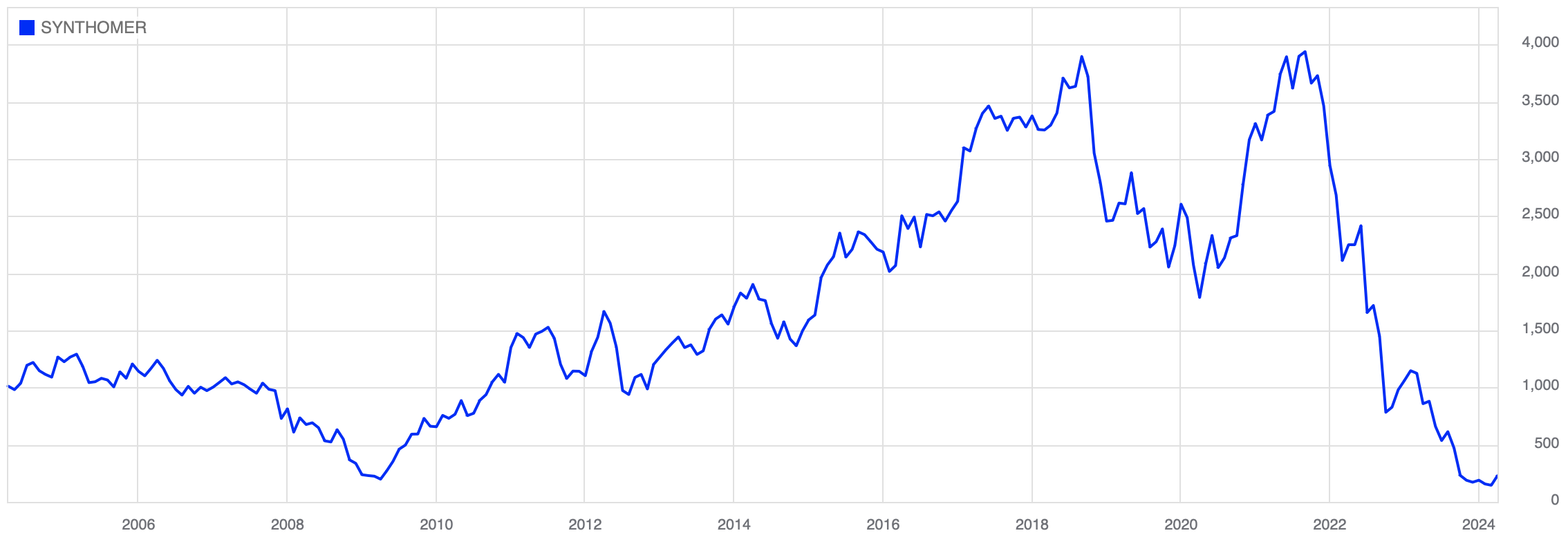
Before we get into the final results, let’s put this price move in context. The Synthomer share price is back to where is was in September 2023. But, that still leaves it 94% below its June 2021 high of 4,066p. This is a big move off a relatively small base. And it could have been a smaller base.
Cap in hand to shareholders
After reaping the rewards of being involved in the latex glove supply chain during the pandemic, a string of analyst price target cuts kicked off a turnaround in the company’s share price fortunes. They belied the company had overstretched itself with a string of acquisitions and worried about supply dropping off a cliff. Debt had gotten out of control. The financial numbers started to show these concerns might have basis. Profits swung from £296.5m in 2021 to a loss of £20.5m in 2022 and at the same time borrowings leapt from £619.5m to £1,234.1.
The CEO opened his 2021 statement by saying that the company was “building on an outstanding year to consistently deliver growth and value”. The 2022 CEO statement started like this “In more challenging times it is more important than ever to be close to our customers, to focus on the things we do best and to follow a clear strategy”. Management turned to restructuring. The company’s laminates, films and coated fabrics business was sold for a song, segmental reporting changed, and underlying and statutory numbers started ti be reported for almost every profit measure as management tried to refocus investors attention away from what it considered one-time charges that had a habit of being anything but. Also, previous results were restated and there was an equity raise of £260.8m in 2023.
So, when analysts started to hype the stock up, investors did not seem interested, until last weeks full-year 2023 numbers. But, remember, sometimes when a stock is this beaten down, it might not be good news that lifts it, but rather news that things are not continuing to get worse. Another thing to note before we dive into the final results is that the in our last short-sellers report Synthomer did not make the top 20: the shorter had presumably already picked the bones clean and departed.
Synthomer final results for 2023
Revenue fell to £1,970.9m in 2023 from £2,332.3m. Synthomer’s coatings & construction solutions saw an 18% drop in revenues and a 145 drop in volumes and posted an operating profit margin (OPM) of 5% versus 6% the year before. The health & protection and performance materials division saw drops of 25% and 14% respectively, and barely broke even at the operating profit level compared to an OPM of 7.1% the year before. Its smallest division, adhesive solutions did increase revenues by 2% and volumes by 10%, but had a negative OPM at -5.6% although that was better than the -22% in 2022.
The overall operating loss was £35.4m, which was worse than the prior years £13.5m. Overall losses came in at £66.8m for 2023, which was worse than the loss of £33.0m in 2022. Diluted earnings per share were (78.5)p in 2023, an even greater loss than the (51.2)p seen in 2023 on a per share basis.
Where is the good news that kicked off that price rise then? Or failing that where is the evidence that things are not getting any worse? Well, the company did manage to generate £150m in cash from operating activities in 2023 compared to £133.9m in 2022. Around £80m of that operating cash flow came from changes in working capital. That means Synthomer has been unwinding excess inventory that it had erroneously built up as well as collecting cash from customers for invoice payments. Net debt has come down from £1,024.9m to £499.7m, but a lot of that was due to the £260.8m from the rights issue. Long term borrowings stand at £870.3m compared to £1,234m the year before.
Maybe those special items—sometimes called one-time charges—falling from £183m in 2022 to £73m was cause for optimism, and a big chunk of both years special item costs was due to non-cash amortisation of acquired intangibles…wait. Amortisation of intangibles is now a special item? Ok, Synthomer. And its always nice to see a CEO get rewarded for positive performance isn’t it? Michael Willome, Synthomer’s CEO, earned £987k in 2023 up from £789k, despite the company’s revenue and earnings declining over his 2.33 year tenure.
Synthomer share price outlook
Analysts have an average share price target of 259p for Synthomer, with a low of 130p and high of 416. Perhaps that, in combination with a final results announcement that could be interpreted positively was all that was needed to kick off some serious upwards price action. But then again, a trading statement in January 2024, was broadly inline with what was revealed in the final results last week, meaning investors should not have been shocked by what they saw.
Synthomer also has a relatively small float now. At the end of 2022, it reported a weighted average number of diluted shares of 468,330,000. This year it’s 85,400,000. That’s a 81.8% drop. Now, thats due in part to the consolidation that happened in September, whereby for every 20 shares that an investor in Synthomer owned, they were reissued with one consolidated share. Even if the number of shares after the October rights issue of 163,600,000 is used its a 65.1% drop.
Generally, smaller float stocks are more volatile, as are stocks that are at lower rather than higher prices. All these things could point to an overreaction to what could be construed as news suggestive off a brighter future for the company and its stock. And management does labour the point that the business is now positioned for growth in the future should end-markets improve, and analysts seem to agree with most pencilling in revenue growth.
A quick note on consolidation
Consolidations raise share prices. Here’s why. If you own 20 shares at 25p, the total position size is 500p. Assuming the consolidation is not interpreted as anything other than a consolidation, then you should end up with one share worth 500p. The per share price has increased. Thats a reason to do a share consolidation as it lifted the price of what was at the time a penny stock back into pound stock territory. Price charts are adjusted to take care of consolidations (and splits which lower the per share price, and are typically used to make investing in a company affordable to more people) which should help investors not be caught out by thinking they have seen a massive price swing that was due to nothing more than a change in the share count.
Another reason for consolidation might be regulatory requirements. The NASDAQ for example can delist a stock for falling below $1 in price. The London Stock Exchange—which is where Synthomer is listed—does not care about share prices, only market caps.
Share consolidations and splits play havoc with per share numbers. The company will adjust last years numbers to account for this, but for prior years an investor is out of luck and will have to do it for themselves. This makes comparisons across time difficult.
DISCLAIMER: James J. McCombie does not own any of the shares mentioned in the article. The Storied Investor has no beneficial ownership position in any of the stocks or securities mentioned. No comment in this article should be construed as a recommendation of, or opinion regarding the future performance of, any stock or security or collection of them mentioned herein. Opinions expressed are the author’s and do not represent the views of The Storied Investor.

 The Storied Investor