
Lloyds Banking Group (LSE: LLOY) stock has history, and not all of it is good. The company can trace its roots back to 1765. It ended up listed on the London Stock Exchange in a roundabout way. TSB, another bank listed in 1986, and in 1995 merged with Lloyds. A series of mergers and acquisitions created the UK banking behemoth that ended up being rescued by the UK government in 2009.
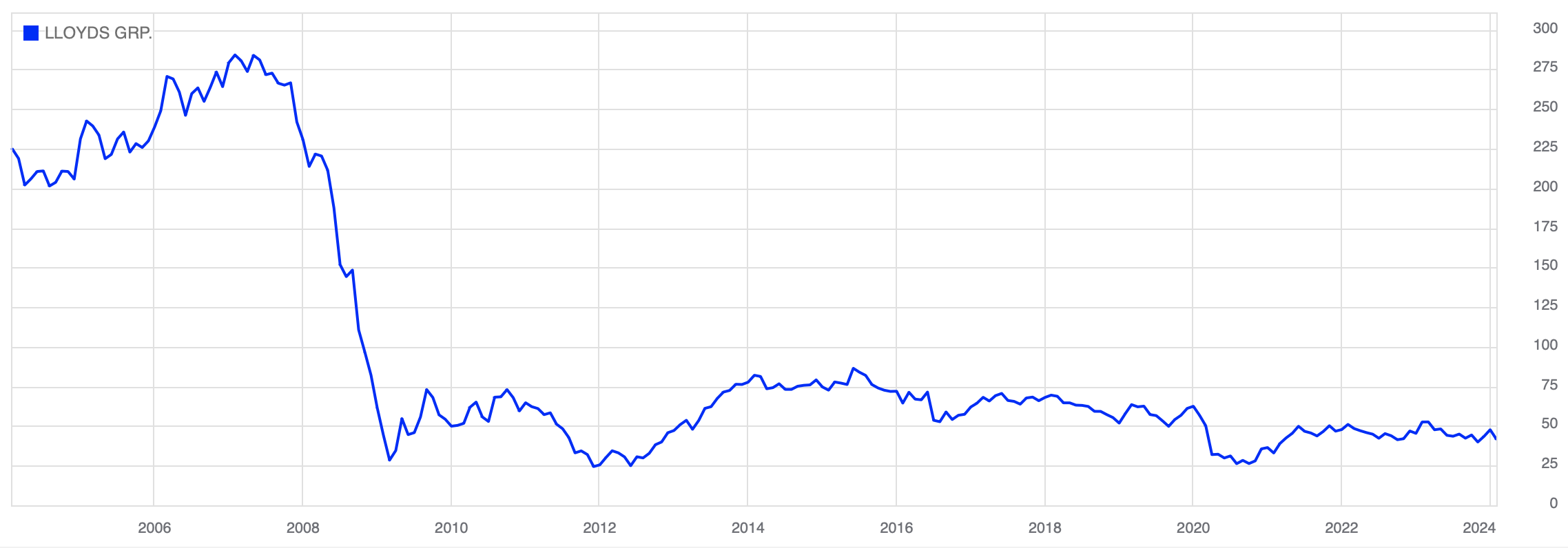
In 2016 Lloyds was back in the hands of private shareholders. But its share price is not back to where it was before the calamitous years of late 2007 to 2009 and that government bail out.
Lloyds share price history:
- The share price started the year at 48p.
- As of the most recent update, the share price has experienced an 8% decline since January 1, reaching 44.2p per share.
- The drop occurred, possibly due to concerns related to weak loan growth, high impairments, and potential regulatory fines related to motor loan commissions.
- Over the last five years, the Lloyds share price has seen a 27.4% decline.
- In 2019, the share price was over 64p per share.
- Since 2009 the share price has been bumping around between 25p and about 90p.
But, even if the share price has been up as many times as it’s been down, investors have had dividends to enjoy. Sometimes thats true. sometimes it is definitely not.
Dividend history:
- Lloyds did not pay a dividend between 2008 and 2014.
- Dividends returned in 2014, but Lloyds faced challenges during the COVID-19 pandemic.
- In 2020, the bank cut its dividend following regulatory pressure, particularly from the Bank of England, as a response to economic uncertainties during the pandemic.
- Post-2020, there has been a growth in dividends.
- Dividends on Lloyds shares have increased since the end of the pandemic.
- The bank reported a lower dividend in 2021 (2.0p per share) compared to pre-pandemic levels but saw a slight increase in 2022 (2.4p per share).
- The dividend payments for the 2023 calendar year totaled 2.52p per share.
Dividend forecasts
- There are conflicting views on the outlook for Lloyds’ dividends.
- Some express optimism, highlighting the potential for further increases in dividends and noting that dividends are expected to be covered 2.2 times by anticipated earnings per share.
- Forecasts suggest a dividend yield of 7.5% in 2024 and 8.3% in 2025, with both prospective dividends being covered 2.2 times by anticipated earnings per share.
- The coverage ratio is considered reassuring, providing a decent margin of safety.
Is Lloyds is a banker
Investors eyeing Lloyds Banking Group (LSE: LLOY) find several compelling reasons to consider adding the stock to their portfolios. First and foremost, Lloyds boasts an impressive earnings record, with remarkable financial performance and earnings per share growth projected at 9.1% over the next three to five years. This solid financial foundation, coupled with lower-than-expected impairment charges, positions the bank as a robust player in the market.
Furthermore, Lloyds demonstrates resilience in the face of economic uncertainties, particularly amidst Brexit-induced headwinds and a sluggish UK economy. The bank’s dominance in the mortgage sector, with an average mortgage customer income of £75,000, serves as a protective factor, insulating it from potential economic pressures. Additionally, the presence of effective hedging strategies and prudent risk management practices gives confidence that Lloyds can weather challenges, especially in the face of rising interest rates.
Lloyds’ attractive quantitative valuation metrics, including a forward price-to-earnings growth (PEG) ratio indicating potential undervaluation, make it an intriguing investment opportunity. The prospect of a high dividend yield, forecasted at 7.5% in 2024 and 8.3% in 2025, further adds to its allure. As interest rates fluctuate, Lloyds’ net interest margin, the difference between what it charges savers and borrowers, remains a potential source of strength, contributing to the bank’s attractiveness as a long-term income investment.
Or is Lloyds a risky proposition?
However, caution prevails in the minds of some investors considering Lloyds. One notable concern arises from the bank’s historical dividend record, marked by a patchy performance. Skepticism intensifies when considering the recent trend of rebasing dividends lower, even after the pandemic-induced challenges eased. This has led to a divergence of opinions, with some interpreting the rebasing as a sign of weakness in Lloyds’ operations and a lack of confidence in sustained earnings growth.
The looming motor loans investigation adds a layer of uncertainty, casting shadows over the bank’s future. The potential £1 billion fine from the Financial Conduct Authority (FCA) raises concerns about the bank’s exposure to losses in this area, creating a level of unpredictability for investors. While the bank’s profitability remains robust, uncertainties surrounding the outcome of the investigation and its financial implications introduce an element of risk that investors may find unsettling.
Moreover, the cyclical nature of Lloyds’ operations, coupled with the broader economic challenges faced by the UK, adds a layer of complexity to its growth prospects. The mature and competitive nature of the UK banking sector, alongside the rise of nimble fintechs and challenger banks, poses a continuous threat to market share and profit margins. As such, investors must weigh the potential headwinds against the positive metrics, ensuring a well-rounded evaluation of Lloyds’ investment merit in a landscape filled with uncertainties. I would not buy this stock right now.
DISCLAIMER: James J. McCombie does not own any of the shares mentioned.. The Storied Investor has no beneficial ownership position in any of the stocks or securities mentioned. No comment in this article should be construed as a recommendation of, or opinion regarding the future performance of, any stock or security or collection of them mentioned herein. Opinions expressed are the author’s and do not represent the views of The Storied Investor.

 The Storied Investor